One Jaipuria Alumni Thought Leadership Forum Explores the Future of HR, Career Skills and Emerging Opportunities
October 06, 2026
Anurag Mohan
Preparing for a rapidly changing world of work
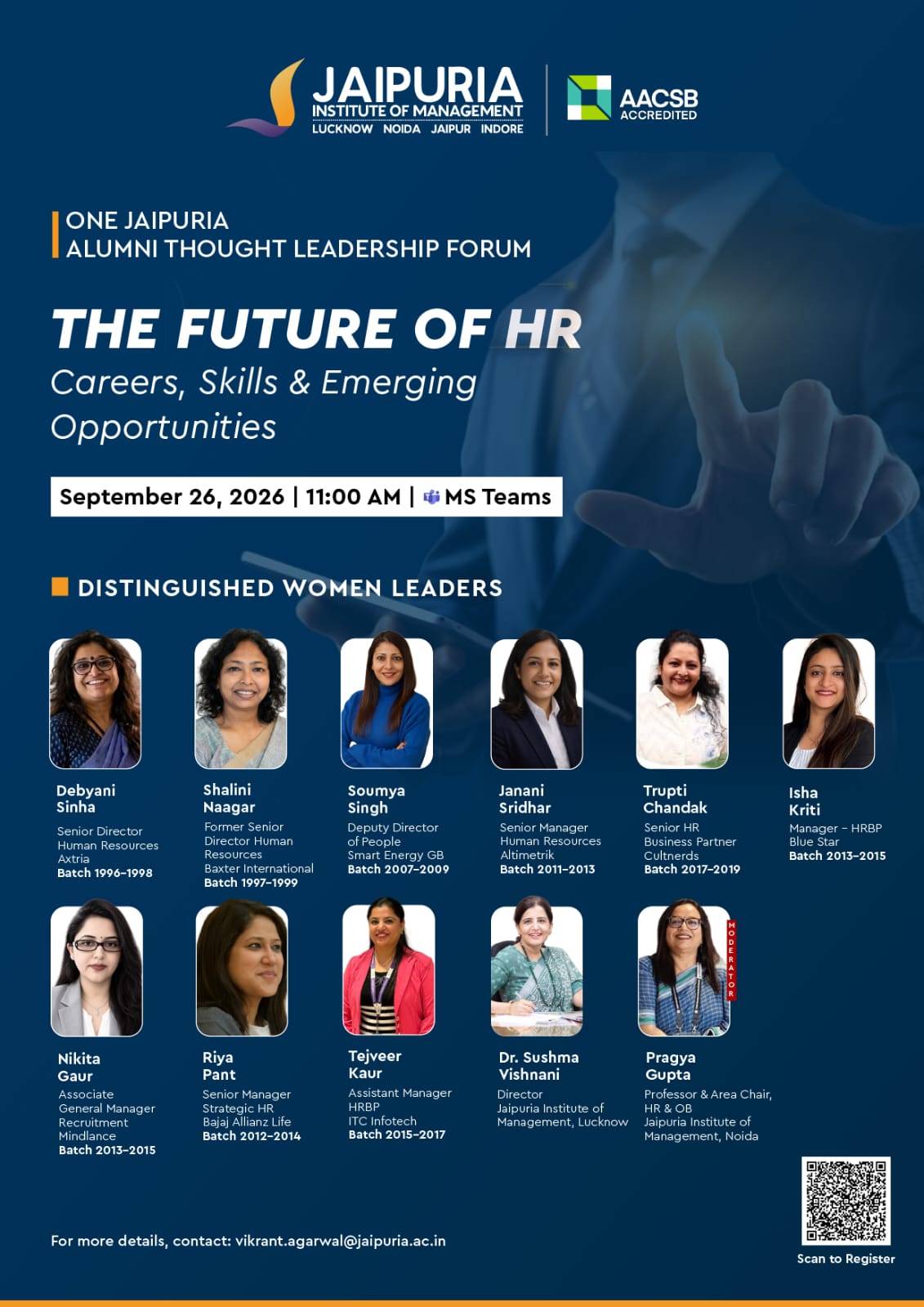
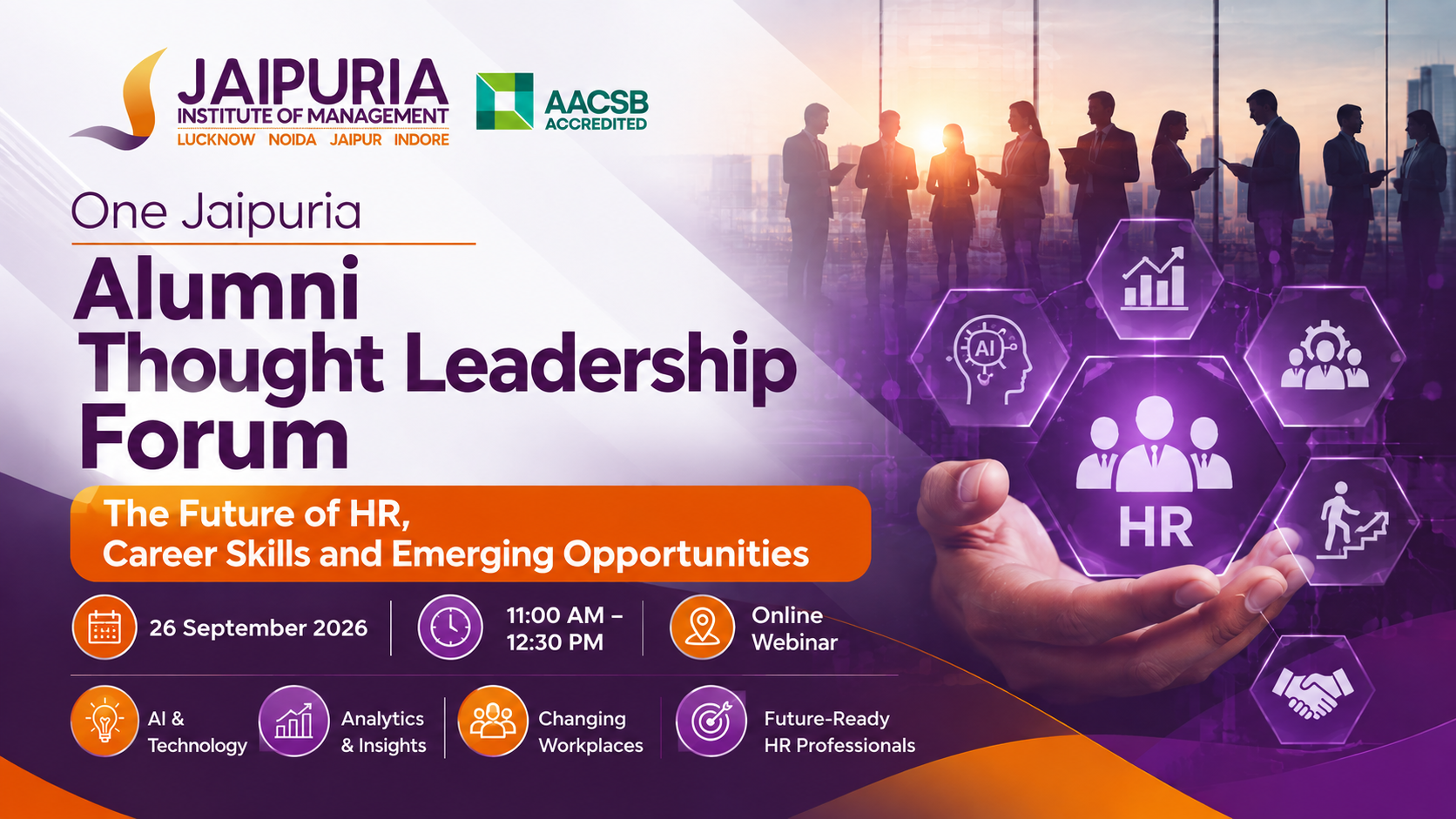
The One Jaipuria Alumni Thought Leadership Forum, held online, on 26
September 2026, brought together alumni, faculty and students for a focused
conversation on “The Future of HR, Career Skills and Emerging Opportunities.”
The forum created a bridge between classroom learning and professional
realities, with experienced alumni sharing practical perspectives on how HR is
evolving in response to technology, analytics, artificial intelligence,
changing employee expectations and new models of work.
Opening the forum, Mr. Vikrant Agarwal, AGM, Alumni Relations,
highlighted the value of bringing the One Jaipuria community together around
subjects that matter to the future of work. Building on earlier thought
leadership conversations around AI, marketing and banking, the forum focused on
HR as a function that is becoming increasingly strategic, data-driven and
business-oriented.
Dr. Sushma Vishnani, Director, Jaipuria Institute of Management,
Lucknow, set the context by drawing attention to the pace of change in the
world of work. Referring to the World Economic Forum's projection that a
significant proportion of skills will change by 2030, she emphasised lifelong
learning and the need for professionals to continually renew their
capabilities. She also highlighted an important shift in how organisations view
people: knowledge, relationships, skills and human capability are not merely HR
concerns, but intangible sources of organisational value.
From HR professional to business professional
A recurring message throughout the forum was clear: the future HR
professional must understand the business as well as the people within it.
Dr. Pragya Gupta, faculty member, emphasised that HR's role extends
beyond traditional processes to include culture, organisational capability,
employee experience, performance and future-ready talent. She also underlined
the importance of keeping the “human in the loop” as technology becomes more
deeply embedded in HR practices.
Ms. Shalini Nagar, an alumna of the MBHR 1997–99 batch, reflected on
how dramatically the HR profession has changed. Recalling a time when choosing
HR as a specialisation could be viewed as limiting one's career options, she
contrasted that perception with today's reality, where HR increasingly has a
seat at the leadership table. Her advice centred on three priorities:
understand the business, keep reinventing yourself through learning, and stay
fiercely human.
For Shalini, business understanding means knowing the organisation
beyond HR: its customers, revenues, costs, strategy, products, research and
development, and sources of competitive advantage. The message was particularly
relevant for young professionals who want to move from being process managers
to strategic contributors.
Digital HR, analytics and the human element
Ms. Soumya Singh highlighted the role of HR in creating an employee
experience that is fair, consistent, accessible and aligned with organisational
goals. She described culture not as an HR-owned initiative, but as a shared
organisational responsibility and an important business enabler.
Ms. Janani Sridhar examined the transformation from paper-based and
manual HR processes to digital platforms and analytics. She explained how
analytics can help organisations move beyond asking what happened to
understanding why it happened, what may happen next and what action should
follow. This progression turns HR data into a basis for better decisions.
Ms. Trupti Chandak brought the discussion into the start-up
environment, where HR professionals often need to understand sales, finance,
workforce planning and broader business operations. She also stressed the
importance of listening to employees and maintaining informal conversations,
because a human-centred approach can help organisations identify concerns
before they become larger problems.
AI, business acumen and the evolving HR professional
The forum's discussion on artificial intelligence was deliberately
practical. Dr. Sushma Vishnani shared examples of AI being used in HR for
activities such as recruitment screening, employee queries and scheduling,
while also pointing to the risks and limitations of excessive reliance on
automated systems. Her central message was that AI can automate routine work,
but judgement, ethics, exception handling and human understanding remain
critical.
She identified five broad capabilities for the future HR
professional: AI fluency, data and financial literacy, judgement and ethics,
human and leadership skills, and learning agility. The goal, she suggested, is
not to compete with the machine, but to use AI as an assistant while remaining
wiser than the machine.
Ms. Isha Kriti further explored the evolution of HR from a largely
administrative function to one that contributes to productivity, leadership
pipelines, cost management and organisational effectiveness. She emphasised
business acumen, data and technology awareness, AI literacy, influencing skills
and critical thinking. AI may assist with analysis, but people still have to
identify the right problem and decide what deserves attention.
Ms. Nikita Gaur brought a similar perspective to talent acquisition.
Recruitment, she explained, is moving from “order taking” to problem solving.
Instead of simply asking how many people need to be hired, HR professionals
must ask why the organisation needs them, whether the requirement is driven by
growth, attrition, a new capability, a changed operating model or technology,
and whether internal development could address the need. Skills, potential,
learning agility and candidate experience are therefore becoming increasingly
important.
Sector knowledge and the future HR Business Partner
Ms. Riya Pant highlighted the importance of sector knowledge through
the lens of BFSI, where regulatory requirements can directly influence HR
strategy, costs, hiring and productivity. She stressed the value of comfort
with numbers, Excel, analytics, communication, integrity, judgement and an
understanding of the industry in which an HR professional operates.
Ms. Tejveer Kaur discussed the evolving HR Business Partner as a
strategic partner, employee champion, coach and, at times, arbitrator. The
future HRBP will need to understand business KPIs, use data and AI
intelligently, customise HR practices to organisational needs and continue to
listen to employees. For freshers, she emphasised learning, listening,
communication, consistency, AI literacy, reading and practical application. She
also pointed to the value of internships, industry interactions, panels and mentorship
in preparing students for the workplace.
Learning through questions and shared experience
Dr. Manisha Seth facilitated the question-and-answer segment, giving
students an opportunity to connect the discussion to their own career concerns.
Questions around future skill development, culture, the capabilities required
of fresh HR professionals and continuous learning brought the conversation back
to the central theme: employability will increasingly depend on the ability to
learn, unlearn and apply knowledge in changing situations.
The forum also reinforced the importance of translating classroom
theory into workplace practice. Dr. Abhinav Rathor noted that HR is not
shrinking, but becoming more complex as organisations deal with evolving people
expectations, technologies and workplace models. His message was direct: “You
can no longer just be an HR person, you have to be a business person.” Dr.
Abdul Qadir presented the Vote of Thanks, expressing gratitude to all
participating alumni and faculty members for their valuable contributions to
the forum.
A simple message with a powerful takeaway
Across the different perspectives, one common thread emerged. The
future of HR will not be defined by technology alone. AI, analytics and digital
platforms will change how work is done, but their value will depend on
professionals who can understand the business, interpret data, exercise
judgement, build trust and remain deeply connected to people.
For students, the message is equally clear: build strong
fundamentals, develop business awareness, become comfortable with technology
and data, keep learning, and strengthen the human capabilities that machines
cannot easily replicate. For experienced professionals, the challenge is to
keep reinventing themselves as the workplace continues to evolve.
The One Jaipuria Alumni Thought Leadership Forum demonstrated the
strength of an engaged alumni network in bringing real-world experience into
conversations that matter to the next generation. It was not simply a
discussion about the future of HR, but a conversation about how professionals
can prepare themselves to shape that future.
Pictures